
Time is the only resource that cannot be replenished. For C-Suite executives, senior partners, investment bankers navigating the corridors of Canary Wharf and Goldman Sachs London, or visiting delegations managing back-to-back appointments across the City of London, every minute lost to unreliable ground transport is a minute taken directly from revenue-generating activity. A professional business chauffeur service is not a luxury supplement to your corporate travel programme — it is a strategic operational asset.
This guide has been written specifically for those who set — or influence — the ground transport standards within their organisations: travel managers, executive assistants, CFOs, and the high-net-worth individuals who simply refuse to compromise on efficiency, discretion, or presentation. What follows is an authoritative, practical breakdown of everything you need to know about commissioning truly elite corporate chauffeur provision in London.
Why Standard Car Services Fall Short of Executive Expectations
There is a significant difference between booking a minicab through an app and securing a business chauffeur service for business travel. The distinction becomes starkly apparent the moment a Managing Director steps off a delayed transatlantic flight at Heathrow Airport, exhausted and under pressure to reach a board meeting in Mayfair within the hour. An app-based driver circling Terminal 5’s drop-off zone with limited tracking capability is categorically not the same experience as a discreet, professionally attired chauffeur waiting in the arrivals hall — name board in hand, luggage assistance at the ready, real-time flight data already processed.
The shortcomings of generic car services in a business context typically cluster around four core failures:
- Inconsistent vehicle standards: An unvetted fleet presents reputational risk, particularly when transporting clients or board-level visitors.
- Lack of discretion: Business conversations — whether a pre-meeting strategy debrief or a sensitive M&A discussion — require an environment of absolute confidentiality.
- Poor punctuality mechanisms: Without live flight tracking, real-time traffic monitoring, and proactive rerouting, delays become inevitable across London’s congested road network.
- Absence of account management: An organisation running 40 or 400 corporate journeys per month requires consolidated billing, reporting, and a dedicated point of contact — not an invoice per ride.
A genuinely premium corporate chauffeur service in London addresses each of these points as a baseline, not as an added extra.
The Anatomy of a World-Class Business Chauffeur Service
The Vehicle: Your Mobile Boardroom
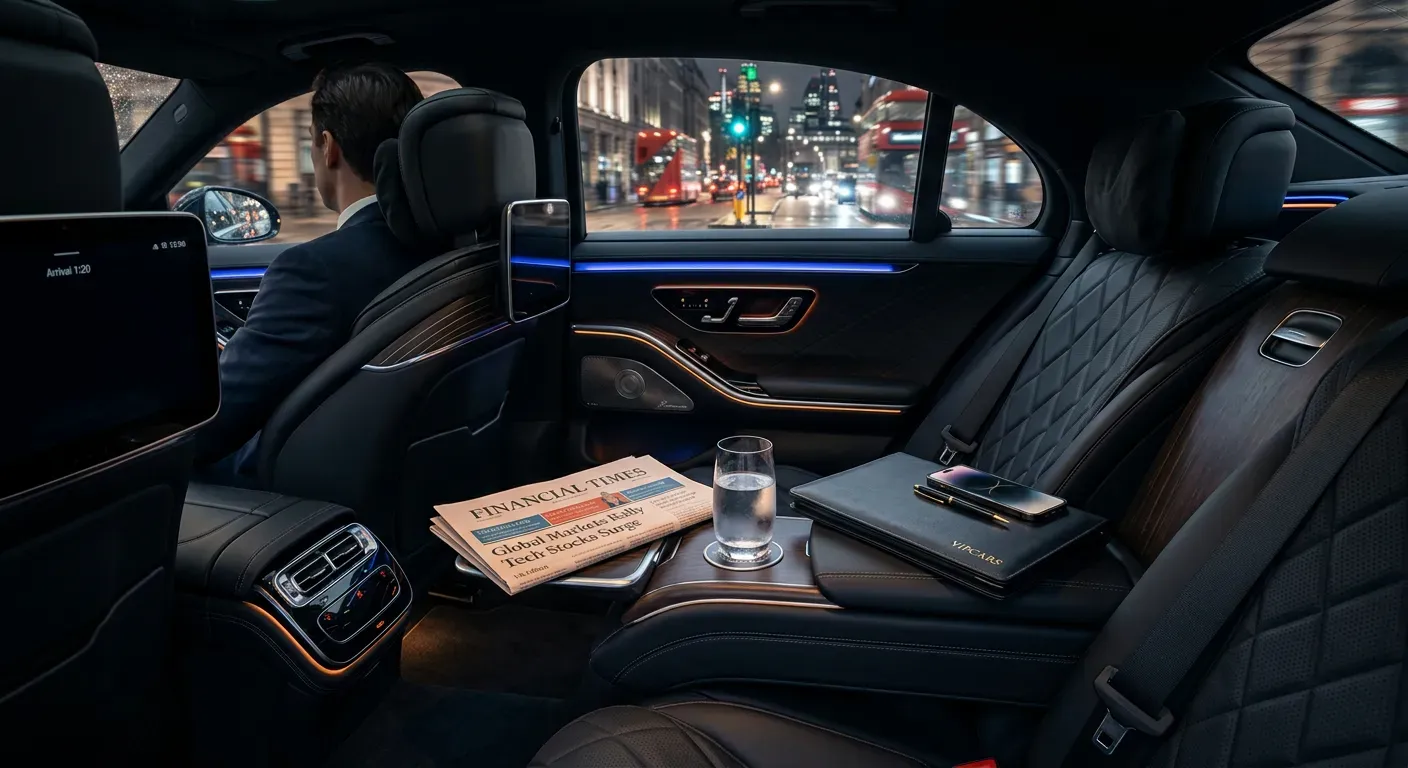
The vehicle is the most visible expression of your corporate values when transporting clients, partners, or dignitaries. The benchmark for executive car hire in London is widely considered to be the Mercedes-Benz S-Class — a machine that combines Autobahn-proven engineering with cabin refinement that rivals many private aviation interiors. With massaging rear seats, ambient lighting, MBUX entertainment architecture, and near-total sound insulation, the S-Class transforms a 40-minute journey from London City Airport to The Shard into productive, pressureless time.
Beyond the S-Class, a properly equipped luxury business transport fleet will typically include:
- Mercedes-Benz V-Class (Executive Edition): The preferred configuration for small delegations, roadshow teams, or group transfers between ExCeL London and the City. Individual captain seats, partition options, and extended legroom make it superior to any minibus alternative.
- BMW 7 Series: An alternative executive saloon for those with brand preferences, offering comparable technology and ride quality to the S-Class.
- Range Rover Autobiography: Favoured for its commanding road presence and high ground clearance — particularly useful for inter-city transfers or countryside estate visits.
- Rolls-Royce Ghost / Phantom: Reserved for the highest-tier client entertainment, state visits, or when the arrival statement is itself part of the commercial strategy.
Every vehicle in a serious business chauffeur service fleet in London should be no older than 12 months, maintained to manufacturer standards, and presented immaculately — interior and exterior — before every single engagement.
The Business Chauffeur Service: Professionalism Beyond the Wheel
The quality of the driver defines the quality of the service. This is an unequivocal truth in the corporate transport sector. A business chauffeur service is not simply someone who holds a private hire licence. They are a vetted, trained professional whose attributes encompass:
- Enhanced DBS (Disclosure and Barring Service) clearance, with background screening appropriate for access to sensitive corporate environments including HSBC London headquarters, Lloyds of London, and Bank of England adjacent properties.
- Immaculate professional presentation: Dark suit, polished footwear, and understated grooming — the standard of presentation expected in any City of London financial institution.
- Advanced driver training: Including defensive driving techniques, hazard anticipation in high-density urban environments, and knowledge of alternative routing across Greater London.
- Discretion as an operating principle: A business chauffeur service does not initiate conversation, does not engage with personal calls in the client’s presence, and treats all overheard information as strictly confidential. This is non-negotiable for executives whose schedules, counterparts, and travel patterns represent commercially sensitive intelligence.
- Emotional intelligence and adaptability: Understanding when a client needs silence to prepare for a negotiation, and when a briefing on current traffic conditions around Westminster is genuinely useful.
Corporate Airport Transfers: Where Precision Is Non-Negotiable
Airport logistics represent the highest-stakes component of any corporate travel itinerary. A miscommunication or delay at Heathrow Airport, Gatwick Airport, or London City Airport creates a cascade of disruption that can compromise an entire day’s schedule — or worse, a client relationship.
A premium corporate airport transfer in London operates on a fundamentally different model to standard hire services:
Live Flight Tracking & Dynamic Scheduling
Your chauffeur’s dispatch team monitors your flight in real time from the moment it departs its origin. If BA284 from New York JFK lands 23 minutes early, your driver is already adjusted and in position. If a Frankfurt connection is delayed due to ATC restrictions, the pick-up schedule flexes without any action required from the passenger. This flight tracking capability is the single most impactful operational feature that separates professional corporate transfer services from their commodity counterparts.
Meet & Greet at All Major Terminals
The meet and greet service for business travellers should extend seamlessly across all London gateway airports:
- Heathrow Airport (LHR): Terminals 2, 3, 4, and 5 — including dedicated Fast Track access arrangements for premium cabin passengers and CIP clients.
- Gatwick Airport (LGW): Both North and South Terminals, with specific knowledge of the inter-terminal transfer timings that frequently catch inexperienced drivers off guard.
- London City Airport (LCY): The preferred gateway for City and Canary Wharf executives — transfers to Fenchurch Street, London Bridge, or the broader EC postcode take under 20 minutes in most traffic conditions.
- Private Aviation Terminals: Including Farnborough Airport, Biggin Hill, and RAF Northolt — the preferred arrival points for ultra-high-net-worth principals travelling by business jet, where discretion and speed of ground movement are paramount.
Luggage Assistance & Terminal Navigation
For international executives carrying presentation materials, samples, or extensive luggage, a business chauffeur service who manages the physical logistics of arrival — trolley, porter coordination, baggage reclaim assistance — removes a layer of cognitive load that is entirely unnecessary for someone transitioning from a 10-hour transatlantic flight directly into a high-stakes commercial environment.
Key Business Travel Scenarios: How Elite Business Chauffeur Service Perform
Roadshow & Multi-Stop Executive Itineraries
Investment banks and asset management firms coordinating equity roadshows across London’s financial district require a ground transport partner who understands the unique tempo of this format. A typical roadshow day might involve seven to nine investor meetings across Mayfair, the City of London, Canary Wharf, and King’s Cross St Pancras — all sequenced within a rigid timetable where a single 15-minute overrun creates a domino effect through the entire day.
Roadshow transport done correctly means:
- Pre-mapped routing with identified contingency routes for each leg, accounting for known congestion hotspots such as the Bank of England junction, London Bridge approaches, and the Aldgate corridor.
- Real-time communication between driver and the roadshow coordinator, so schedule adjustments are relayed and actioned instantly.
- A discreet, quiet cabin environment between meetings — allowing the senior banker or CFO to review materials, take calls, or simply decompress.
- Absolute reliability on timing: arriving two minutes early is acceptable; arriving two minutes late is not.
Conference & Corporate Event Transport
London hosts some of Europe’s most significant corporate events, from the financial services summits at ExCeL London to technology conferences at Olympia London, large-scale corporate gatherings at the O2 Arena London, and global sporting hospitality at Wembley Stadium. Managing delegate transport for these events — whether for a small executive party of four or a tiered VIP programme for 50 attendees — requires logistical planning that extends well beyond booking a vehicle.
A comprehensive conference transfer programme will include staggered arrival and departure scheduling, pre-assigned vehicles to named passengers, driver briefings on venue access protocols, and a dedicated operations contact available throughout the event duration.
Inter-City & Long-Distance Executive Transfers
Not all business travel in the UK begins or ends at an airport. Executives travelling between London and Birmingham, Manchester, Edinburgh, or the Home Counties for site visits, client meetings, or residential retreats often find that a chauffeured transfer is preferable to first-class rail — particularly when the schedule is fluid, the party is larger than one, or when confidential work needs to be conducted in transit.
A door-to-door service from a central London address such as a Mayfair hotel or Westminster office directly to a client’s country estate eliminates every friction point associated with rail travel: station arrivals, luggage handling, connecting services, and the entirely public nature of even a first-class train carriage.
Corporate Accounts: Streamlining Business Travel at Scale
For organisations with consistent ground transport requirements — law firms, investment banks, management consultancies, pharmaceutical companies, and multinational corporations with London offices — a corporate account arrangement delivers operational and financial benefits that are simply unavailable on a booking-by-booking basis.
What a Corporate Account Delivers
| Feature | Ad-Hoc Booking | Corporate Account |
|---|---|---|
| Billing & Invoicing | Per journey, individual payment | Consolidated monthly invoicing with cost-code allocation |
| Booking Process | Manual, per-booking | Dedicated online portal or account manager |
| Driver Consistency | Random allocation | Preferred driver assignment for regular principals |
| Reporting | None | Monthly travel reports by cost centre, traveller, or journey type |
| Priority Availability | Subject to general fleet availability | Guaranteed vehicle allocation, including last-minute requirements |
| Pricing | Standard rates | Negotiated volume pricing and rate transparency |
| Account Management | None | Named relationship manager with clearly stated contact hours |
For a travel manager overseeing executive mobility across a firm with multiple senior stakeholders, the corporate account model transforms ground transport from an administrative burden into a frictionless, auditable function. VAT-compliant invoicing, expense management integration, and duty-of-care reporting are no longer afterthoughts — they are built into the service architecture.
Navigating London: Local Intelligence That Matters
London’s road network is, frankly, one of the most operationally complex urban environments in the world. The combination of the Ultra Low Emission Zone (ULEZ), the Congestion Charge zone, restricted turning movements throughout the City of London, and the perpetual unpredictability of construction works — from the ongoing developments around King’s Cross St Pancras to the perennial complications near London Bridge — means that routing expertise is not a minor benefit. It is foundational to the service.
An experienced London business chauffeur service will know, for example, that:
- The approach to The Shard on London Bridge Street is subject to significant pedestrian and taxi congestion between 08:30 and 09:30 on weekdays, making the St Thomas Street approach considerably more efficient for punctual arrivals.
- The roads immediately surrounding St Paul’s Cathedral and the Bank of England are subject to cycle lane restrictions that significantly alter viable routing for large executive vehicles during peak hours.
- Corporate visitors arriving at Canary Wharf for meetings at major financial institutions benefit from drop-off points that vary significantly depending on whether the destination is the north dock, south dock, or the Crossrail (Elizabeth Line) interchange area — each of which has implications for parking, waiting, and collection logistics.
- The approach to Goldman Sachs London at Plumtree Court in the City of London requires specific security awareness, as with many Tier 1 financial institutions that have vehicle access protocols for their immediate vicinity.
This granular, constantly updated local intelligence is what separates a business chauffeur service with genuine London expertise from a driver who simply follows a navigation application.
Discretion, Privacy & Security: The Unspoken Requirements of Corporate Travel
Senior executives, particularly those operating at board level within FTSE 100 and global investment banking environments, carry an implicit security consideration that rarely features in the marketing language of standard car services. The movement patterns of a CEO, the meeting schedule of a deal team, the arrival logistics of a visiting sovereign wealth fund representative — this information has material commercial and, in some cases, personal security significance.
A professional VIP business chauffeur service provider operates with protocols that reflect this reality:
- Non-disclosure agreements as standard for all chauffeurs and operational staff.
- Secure communication channels for booking and schedule transmission — not consumer messaging applications.
- Vehicle security sweeps available for diplomatic and high-profile principal transport.
- Close Protection integration: For principals who travel with a security detail, a reputable business chauffeur service will have established protocols for working alongside CPOs (Close Protection Officers) — whether provided by the client or, in some cases, by the transport firm itself.
- Data handling compliance: Full GDPR compliance with respect to passenger data, travel histories, and corporate account information.
The discretion of a truly professional business chauffeur service is perhaps best illustrated by what does not happen: there is no social media activity referencing notable passengers, no conversation with other drivers about prominent clients, and no engagement whatsoever with media or external parties regarding the movements of the individuals in their care.
How to Evaluate a Business Chauffeur Service Provider: A Practical Checklist
Given the proliferation of services marketing themselves as premium corporate transport in London, the following criteria provide a reliable framework for evaluating genuine quality versus polished marketing:
Fleet & Vehicle Standards
- Are all vehicles owned by the company, or subcontracted? Subcontracting introduces quality inconsistency.
- What is the maximum vehicle age within the fleet? (Best-in-class: 12 months for flagship vehicles.)
- Are ULEZ and Congestion Charge compliance costs transparently handled — or passed as hidden charges?
Driver Vetting & Training
- Are all drivers subject to enhanced DBS checks and annual re-screening?
- What is the driver training programme — and does it include advanced driving qualifications from recognised UK bodies?
- Are drivers directly employed, or self-employed contractors? (Employee status typically indicates stronger accountability and consistency.)
Operational Infrastructure
- Are the firm’s support hours and contact arrangements clearly stated — and are enquiries handled by people, not an automated response system?
- Does the firm offer live flight tracking as standard, not as an optional upgrade?
- What is the contingency plan for vehicle breakdown or driver unavailability with less than two hours’ notice?
Corporate Account Capability
- Can the service integrate with your firm’s existing travel management system (TMS) or expense platform?
- Is reporting available at cost-centre or individual traveller level?
- Does the firm carry appropriate liability and public liability insurance for corporate transportation?
Business Class Travel, Reimagined on London’s Roads
There is an instructive parallel between the evolution of business class travel in commercial aviation and the stratification of corporate ground transport in London. Just as the distinction between economy and business class is no longer simply about seat width — but rather about the entire experience from kerb to gate — so too has the definition of a professional business chauffeur service evolved beyond the vehicle and driver into a complete, end-to-end experience.
Consider the cumulative experience of a senior executive arriving for a significant week of meetings in London:
They land at Heathrow Airport Terminal 5 after an overnight flight from Singapore. Their business chauffeur service — briefed on the itinerary two days prior — is positioned in the CIP arrivals area, having monitored the flight through its entire sector. The executive is escorted directly to a waiting Mercedes S-Class, luggage loaded before they reach the vehicle. The cabin temperature has been pre-set. A chilled still water and the morning’s Financial Times are on the rear console. The route to their Mayfair hotel has been adjusted in the last 40 minutes to account for an incident on the M4, and they will arrive 12 minutes ahead of schedule — enough time to freshen up before a breakfast meeting at The Connaught.
For the remaining four days, the same level of operational precision applies across a schedule that spans Westminster, the City of London, Canary Wharf, an evening engagement at a private members’ club in Mayfair, and a departure transfer back to Heathrow. Every transition is seamless. Not once does the executive need to think about transport logistics.
That is the standard. That is what a genuinely elite business chauffeur service in London delivers — not as an aspiration, but as the consistent, repeatable baseline of every single engagement.
Establishing Your Corporate Travel Standard: Next Steps
For organisations seeking to elevate their ground transport provision — whether transitioning from an incumbent provider, formalising a previously ad-hoc arrangement, or establishing a corporate account for the first time — the process is straightforward with the right partner.
An initial consultation with a senior account manager should encompass:
- A review of your current monthly journey volumes and primary routes — including all corporate airport transfers in London and inter-city movements.
- Identification of your key principals and their individual preferences (vehicle type, driver preferences, communication style, in-vehicle requirements).
- Discussion of invoicing and reporting requirements to ensure seamless integration with your finance and travel management functions.
- Agreement on SLAs for booking lead times, driver allocation, and contingency response.
The finest business chauffeur service in London do not ask you to adapt to their processes. They build their service around the operational realities of your organisation — because they understand that, at this level, service is not a product. It is a partnership.
Your time, your reputation, and your clients’ experience are not variables to be optimised. They are the standard to be protected, consistently and without compromise, every single journey.